
Thinking Fast is Thinking Dumb
The Complexities of the Tragic Killing of the DC National Guard (Vol. 5; Issue 48)

Thinking quickly about certain situations can save your life. If you’re sipping coffee in a cafe when an AK-47-wielding assailant storms in, focusing only on your survival serves you best. You might drop to the floor or look for a backdoor exit. Perhaps, you’ll grab a heavy object, like a lamp, to use as a weapon. The situation calls for anything but deliberation. It calls for immediate, concrete action.
In such a terrifying situation, luxuriating in complex thinking could kill you. Thoughts about the childhood of the attacker, or wondering if he or she was motivated by poverty, or by a gang’s demand for violence, deserve no attention. The most basic ego defense mechanisms (Freud, A., 1936), namely splitting and projection, will dominate. The aggressor is evil; you are good. Whatever badness you struggle with in yourself becomes projected onto the attacker. It is a black-and-white situation.
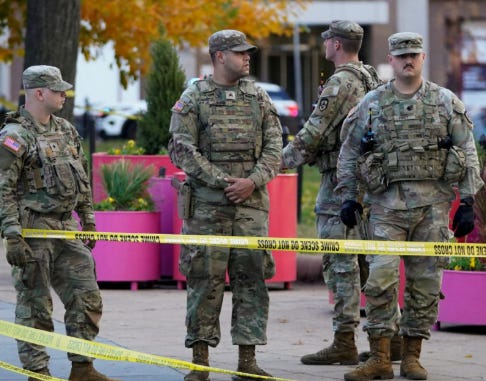
In contrast, last week’s tragic killing of National Guardsman Sarah Beckstrom, and the serious injuring of her colleague, Andrew Wolfe, requires the highest level of complex reflection. However, and unfortunately true to form, Trump reacted in the simplest possible way. Because the assailant, Rahmanullah Lakanwal, was an Afghan national, Trump ordered an immediate end to processing asylum applications from all Afghans living in the US. His reaction was impulsive, foolish, and blind.
Even a cursory analysis of this most recent instance of political violence reveals dizzying levels of complexity. It involves, at a minimum, analyzing Trump’s policy of using the National Guard to “fight crime” in US cities, understanding the history of the asylum process, and considering the US invasion of Afghanistan (during which Mr. Lakanwal assisted US troops.) Let’s consider them one by one.
A few months ago, Trump deployed 2,000 National Guard troops to DC for what he described as a crackdown on crime. The mayor of DC objected. Such a deployment made sense in the wake of the January 6, 2021 insurrection; it made no sense for November 2025. It appears Trump wished to exercise typical authoritarian muscle, namely an ability to show power even when unnecessary.
Interestingly, despite their deployment and their “deputization,” Ms. Beckstrom and her colleagues lacked any real law enforcement powers. They had been patrolling metro stations and picking up trash. They could not actually arrest “criminals” (Yousif, 2025). Had Trump not decided to castrate local law enforcement by mobilizing the National Guard, this tragedy would not have occurred. Just what were these young officers doing there in the first place? Federal law generally prohibits the use of the US military for domestic law enforcement. Trump’s deploying them made them an easy target for a disenchanted, mentally unstable person.
In retrospect, using the need for political or personal asylum as a reason for immigrating to the US has proven a huge mistake. What was intended to be a humanitarian gesture, a fair reason for seeking refuge in the US, quickly became misused and abused. At its peak, 2,500 illegal immigrants crossed the border from Mexico every day, allegedly seeking asylum. They were processed, scheduled for hearings, and then released. Many never appeared for subsequent legal procedures. In any event, the immigration system became completely overwhelmed by the sheer number of them.
Republicans and Democrats alike have decried the policy for some years. Few disagree that the immigration process needs a complete overhaul. However, simply expelling all immigrants is to use too blunt an instrument to solve the problem. You cannot promise one thing for years, and then renege on it in an instant. But again, rather than striving to thoughtfully craft legislation to revise the ways immigrants can come into our country, Trump shouts:
GET OUT.
And, finally, the ill-advised invasion of Afghanistan in October 2001 represents another contextual factor. That military operation, ordered by then-President George W. Bush in response to the September 11th attacks, intended to dismantle al-Qaeda and overthrow the Taliban regime that harbored them. Instead, it became a two-decade fiasco that left the Taliban more powerful than ever.
Mr. Lakanwal had worked with the American CIA during that conflict. He led a group of former Afghan military personnel who coordinated with US and British forces (Schecter, 2025). Who could blame Mr. Lakanwal and his family for seeking asylum in the US after it withdrew from the country? His request starkly contrasts with the many who abused it: Mr. Lakanwal understandably feared for his life. He was able to immigrate into the US, on humanitarian grounds, in 2021. His application for asylum was granted earlier this year, but he had yet to receive a green card.
According to a former Marine commando who worked with him, Mr. Lakanwal developed psychiatric symptoms in reaction to the 2024 killing of his close friend and fellow Afghan commander. That individual’s efforts to obtain asylum here were unsuccessful. Mr. Lakanwal allegedly became anxious, depressed, and paranoid. A tragic irony given Trump’s now ending of asylum for Afghans, Mr. Lakanwal feared he’d be deported back to Afghanistan. He became socially isolated, drove across the country multiple times, and never received treatment for his serious mental health condition. In brief, he became a wreck*.
Reacting like an angry toddler (Drezner, 2020), Trump ended the processing of asylum requests, even for Afghans who, like Mr. Lakanwal, had assisted the US military. What an unthinkable betrayal. These individuals, well-known to Taliban officials, will certainly be tortured and killed if returned to Afghanistan.
The attack on those DC National Guardsmen oddly triggered Trump’s other racist agendas. He now seeks to block asylum requests for Somalis as well as Afghans. That grievance apparently stems mostly from his long-standing feud with US Representative Ilhan Omar, a Muslim from Somalia. Last Tuesday, Trump called the Somali population:
Garbage
who deserve to be
Sent back to where they came from.
White House press secretary Karoline Leavitt called Trump’s racist remarks “amazing” and an “epic moment” (Flowers, Oliphant, Hood-Nuno, and Ax, 2025).
In the final analysis, Trump’s reaction to this extremely complex situation resembles the primitive mental functioning typical of a 3-year-old child. It does nothing to seriously address this horrific tragedy of the incident. Trump regresses into using a human’s most primitive ego defense mechanisms, namely splitting and projection. We are good, they are evil. And, naturally, his press secretary spins the regression in a bizarre way. How could Trump’s infantile behavior be “amazing” or “epic?”
It is beyond shameful that a US President models such immaturity to the American people and to global citizens. In truth, this tragic event, ending in the killing of a young soldier and the serious injuring of another one, has immensely complicated roots.
__________________________________
*How a mentally disturbed individual could get easy access to lethal weapons in the US is, of course, but one of many other problems contributing to this grievous assault.
Enjoying this newsletter? Consider a free subscription and share it with a friend.
And check out my book, Lover, Exorcist, Critic: Understanding Depth Psychotherapy, available on Amazon.
References
Drezner, D. (2020). The Toddler in Chief: What Donald Trump Teaches Us about the Modern Presidency. Chicago: The University of Chicago Press.
Flowers, B., Oliphant, Jl, Hood-Nuno, D, and Ax, J. (12/5/2025). Trump ‘garbage’ rhetoric about Somalis draws cheers from administration, silence from Republicans and alarm from critics. Reuters.
Freud, A. (1936). The Ego and the Mechanisms of Defense. London: Routledge.
Schecter, A. “D.C. (11/28/25) National Guard shooting suspect identified as Afghan national who had worked with CIA. Here’s what we know.” CBS News. https://www.cbsnews.com/news/suspect-dc-national-guard-shooting-afghan-national-what-we-know/
Yousif, N. (11/28/25) “National Guard member dies after shooting in Washington DC.” BBC News. https://www.bbc.com/news/articles/cwyx4y6007lo
This analysis is excellent, on a par with or superior to articles I have read in highly regarded national publications such as the New York Times, Harper’s and the Atlantic. You thoroughly explored this multi-faceted tragedy with sensitivity and clarity.
High praise from a brilliant fellow writer. Thanks so much, Susan. I really appreciate your interest in my essays, and I send you care and affection, Alan