
Paranoia, Hysteria, and The Resistance
How Two Opposing Personality Styles Impede Effective Political Organization (Vol. 6, Issue 5)

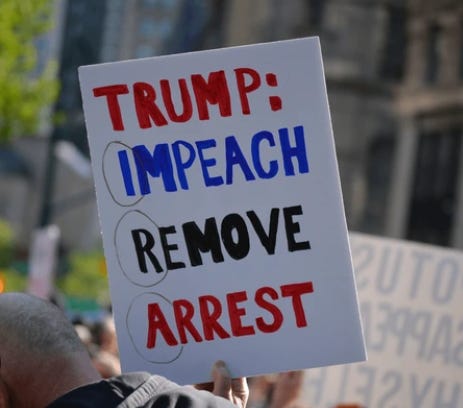
Hysteria, a word derived from the Greek and Latin words for uterus, sounds terrible. A preferable term, histrionic, hardly flattering, better describes individuals with extreme emotional sensitivity. This personality style, along with its opposite, the paranoid one, offers another perspective on the difficulty of developing effective resistance to the rise of authoritarianism. Like quartz running through granite, our personalities have streaks along the spectrum of these styles. They lie on a continuum, with histrionic types at one end and paranoid ones at the other (Verhaeghe, 2011). Before delving into their relevance to politics, consider the remarkable contrast between them.
Histrionic individuals are emotionally insecure. Typically, they express their emotions through chaotic emotional outbursts or physical symptoms. They live in a state of doubt; they internalize conflict. Persons with paranoid styles,* conversely, operate with rigid, absolute certainty. They project blame outward, sometimes to delusional levels. Ironically, beneath their façade, they are just as emotionally unstable as histrionic people.
This continuum of traits makes sense when considering our inner worlds or, better, our “internal dramas” (Karbelnig, 2020). R.W.D. Fairbairn (1952), an object relations theorist, thought these traits result from abandonment or neglect, which is inevitable even in the best childhoods. Histrionic persons, in essence, blame themselves for that emotional injury. Any anger they feel regarding it is turned inward. As a result, they feel unworthy. Their emotional insecurity remains within the self.
In contrast, paranoid persons project the injury outwardly. They anticipate rejection coming from external sources rather than internal ones. The projection explains their suspicion of the outside world. The same process applies to their management of anger. Unsurprisingly, individuals with paranoia express anger outwardly.
These personality styles mirror one another in an unusual, almost mathematical fashion. Joining the list of other reasons, such as denial, complacency, and social withdrawal, the continuum between histrionics and paranoiacs also explains why we see little effective political organization to facilitate our return to democracy.
Histrionics, due to their chronic insecurity, look outward for an authority to reassure them. Freud’s (1921) work on group psychology suggests that charismatic leaders can provide the sense of security these individuals so desperately seek. Think of how Trump offers simplistic solutions to highly complex problems. You may not like him, but he is certainly a master salesman. Those on the histrionic end of the spectrum find his words reassuring.
Paranoiacs find comfort in Trump too, but for entirely different reasons. They identify with his paranoia, e.g., blaming the country’s woes on immigrants, on universities, or on NATO. Trump’s propensity to dominate resonates with them. Instead of projecting persecution, they project themselves onto the “master.” Trump fears the same things as they do. He will protect them from persecution.
When recently asked by a reporter if he recognizes constraints on his actions, Trump replied:
My own mind [is] the only thing that can stop me. My own morality.
The certitude reassures histrionics; paranoiacs identify with it. The inner insecurity that lies on both ends of the histrionic-paranoiac spectrum needs Trump’s confidence, and, therefore, leans towards supporting him. This neediness blinds them to seeing what’s really happening.
And this is what’s happening: Once the great experiment in democracy, America has already lost its characteristic checks and balances. Congress has been neutered, the Supreme Court enables Trump, and he garners ever more power. An armada arrives near Iran, ready to strike in ways rendering the Middle East even more unstable. Because artists are embarrassingly (for Trump) fleeing the Kennedy Center, Trump closes it for “renovation.” In brief, a childlike megalomaniac runs the country, essentially untethered.
Like other would-be dictators, Trump surrounds himself with a cabinet of sycophants who praise him and repeat his lies in the hope of gaining their own power. Billionaire CEOs from the petrochemical to the technology industries support Trump’s every whim. He, in turn, supports theirs.
NYU historian Ruth Ben-Ghiat (2026) believes that dictators operating within such isolated bubbles ultimately fail. Because they cut themselves off from expert advice, they begin enacting their own plans, however insane they may be. Eventually, their behaviors overtly expose their incompetence. Ben-Ghiat writes:
The result: a disillusioned population that loses faith in the leader and elites who begin to rethink their support.
Disillusionment with the leader is already evident. A recent poll by the Economist shows 56 percent of Americans disapprove of his performance, while 38 percent approve. Elites remain on the fence. Unfortunately, it is way too early to hope that Ben-Ghiat’s prediction comes true.
A much greater and better-organized resistance to his rule is needed. We cannot afford to wait for the allegedly self-destructive bubble to burst. Both histrionics and paranoiacs would find any dictator attractive: one obtains support from them, and the other obtains representation. Mature individuals, enjoying both inner security and a basic (if cautious) trust in others, want their voices heard and represented. They seek a representative rather than a master.
If we care about the future of America, we must combat not only rampant apathy but also the impact of these problematic personality traits. People at the extremes of the continuum support Trump, but for reasons more imaginary than real. Histrionics need to find strength in themselves and in others; paranoiacs also need to cultivate trust within themselves and in others. It is crucial that whatever the obstacles to social cohesion, whether complacency, histrionics, or paranoia, they must be overcome to stop the Trumpian march to dictatorship.
________________________________
*Narcissistic styles are but a variant of paranoid ones; they share in the projection of vulnerability or blame onto others.
Enjoying this newsletter? Consider a free subscription and share it with a friend.
And check out my book, Lover, Exorcist, Critic: Understanding Depth Psychotherapy, available on Amazon.
References
Ben-Ghiat, R. (2026). History shows Trump’s worst impulses may backfire on him. New York Times. (Published as a guest essay on February 1, 2026).
Fairbairn, W.R.D. (1952). Psychoanalytic studies of the personality. New York, NY: Routledge.
Freud, S. (1921). Group psychology and the analysis of the ego. Standard Edition, 18:67-143.
Karbelnig, A. M. (2020). The theater of the unconscious mind. Psychoanalytic Psychology, 37(4): 273–281. https://doi.org/10.1037/pap0000251.
Tracking the presidency: 379 days into Trump’s term. Economist, published February 3, 2026.
Verhaeghe, P. (2011). Love in a Time of Loneliness: Three Essays on Drive and Desire. London: Routledge.
Good commentary, Alan. Let me add the suggestion that the two personality types you describe are not found exclusively among Trump's supporters (though they indeed are), but also among some of his most ardent opponents on the streets (and online). Game theory comes to mind here. One of the things that made the SCLC protests for civil rights so effective was the highly disciplined, dignified, and orderly nature of those protests--with the organizers knowing well what tat would emerge from which tit in the game of protest. For example, highly peacefully baiting Bull Connor into excesses that turned the average American toward support of the civil rights movement. We see some of this out there these days, but too often we see a kind of undisciplined and frantic form of 'resistance' that is less effective.