
Inflamed by the "Department of War"
A Name Change from "Defense" to "War" Sends a Globally Disturbing Message (Vol. 6; Issue 10)

The United Nations, which developed out of the ashes of World War II, intended to create a world order based on diplomacy and peace. It took shape in 1945, just as the war ended. The tragedies of that conflict drove the international community to strive for dialogue over discord. Paralleling such civilizational maturity, in 1949 the United States changed the name of its military establishment from the Department of War to Department of Defense (DoD). Deeming our armed forces “defensive” rather than “offensive” aligned with these conciliatory aspirations.
Contrary to these efforts towards rapprochement, Trump named the former defense department the Department of War last September. In doing so, he chose to express offensiveness rather than defensiveness. Soon thereafter, Trump single-handedly ordered US military forces to extract Maduro from Venezuela and, more recently, to attack Iran. He now eyes regime change in Cuba. Neither these active military operations nor the recent renaming of the defense department received the approval of our now-neutered Congress.
Trump’s actions impact the world order because, as it turns out, words matter.
The phrase drilled into us as children, namely, sticks and stones will break your bones but words will never hurt you, is patently false.
We humans unconsciously inhale the culture around us as it manifests in language. Jacques Lacan (1978, 2002), a French psychoanalyst and philosopher, called this obscure conglomeration of culture, law and social norms the Big Other (le grand Autre). It is an abstract, authority-driven structure that dictates how we think, feel and behave.
You would watch the Big Other in action if you were to observe babies as they transition into toddlers and beyond. They experience what Lacan calls the “symbolic order,” a system of language, symbols and signs that is part of the Big Other.
Trump’s emphasis on war instead of defense illustrates the power of words on culture as a whole. Consider any number of correlates in everyday life. You lock the door to your home, but you don’t put a sign on it reading, “If you try to open this door, I’ll kill you.” You activate your car alarm system, but you don’t have a device that sprays poisonous gas on anyone walking near it. You take vaccinations to prevent infectious diseases, but you don’t walk into public spaces toting guns to ensure no one gets within 25 feet of you.
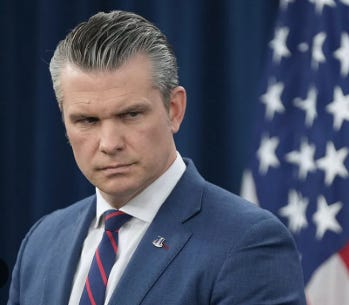
Trump’s government broadcasts clearly threatening messages to the world well beyond a simple change of wording. Pete Hegseth, Fox News-commentator-turned-Secretary-of-Defense, vividly illustrates the new aggression in his recent public comments. Regarding the attacks on Iran, known as “Operation Epic Fury,”* he said:
We’re crushing the enemy in an overwhelming display of technical skill and military force.
Speaking generally about the new assaultive style, Hegseth declared:
If you kill or threaten Americans anywhere in the world, as Iran has, then we will hunt you down, and we will kill you,
adding,
We don’t fight with stupid rules of engagement.
Trump has joined with Putin who, by invading Ukraine in February 2022, broke the 75-year tradition of avoiding aggression between nations. Like Putin’s, our country also emanates an intention to fight, to kill, to destroy. We won’t just defend ourselves. We no longer want to play nicely on the playground; we want to scuffle. Trump, Hegseth and other administration officials regularly spout rhetoric typical of the strongman.
At the Minnesota State Fair in September 1901, Teddy Roosevelt riffed on an African proverb when he famously proclaimed:
Speak softly and carry a big stick.
The sentence reveals Roosevelt’s emphasis on diplomatic negotiation backed up by a military capability. Trump reverses the logic. His renaming of the American military establishment declares:
WE CARRY A BIG STICK AND WE’LL PROBABLY USE IT, SO WATCH OUT!
Trump’s communication of force, of dominance and of rejecting rules of engagement conveys unabashed hostility to the world. It threatens; it frightens. And, for those more interested in diplomacy than combat, it elicits shudders of pain and embarrassment. The antagonistic attitude may even cause some to feel humiliated by its impact on what it says about “being an American.”
_________________________________
*This phrase itself, standing alone, validates the new American pugnaciousness.
Enjoying this newsletter? Consider a free subscription and share it with a friend.
And check out my book, Lover, Exorcist, Critic: Understanding Depth Psychotherapy, available on Amazon.
References
Lacan, J. (1978). The Seminar of Jacques Lacan, Book XI: The Four Fundamental Concepts of Psychoanalysis. J. Miller (Ed.). Trans. A. Sheriden. New York: Norton.
Lacan, J. (2002). Ecrits. (B. Fink, Tran.). New York, NY: W. W. Norton & Company.