
Can the "Big Lies" be Countered?
Fears of American Government Propaganda Become Realized (Vol. 5; Issue 49)

Imagine that you begin to feel persistent pain in your right knee, and someone in your close circle of friends tells you that eating carrots caused it.
Hmmm, you might think, I’ve never ever heard of such an etiology.
Your friend makes no mention of athletic injury, arthritis, or gout, so you explain that hiking makes the pain flare up. If your friend continues with the carrot theory, you may well have to reconsider the relationship. Surely you’d wonder how a rational person could spout such nonsense.
The US government is engaged in a similar level of misinformation, but at a civilization-threatening scale. Instead of simply spreading stupidity, it deliberately deceives the American public. As of a few weeks ago, the Environmental Protection Agency (EPA) website no longer listed fossil fuels as a cause of climate change. Someone interested in the problem of global warming, a middle-school student working on an essay, for example, might look to the EPA for answers.
You’d think they could expect truthful information from a major United States government agency. Instead, they’d find outright lies. Major empirically based studies have established that burning coal, oil, and natural gas and industrializing animal agriculture account for some 80 percent of global warming (Stocker et al, 2023). Nonetheless, when opening EPA’s website, these curious individuals would find only mentions of “natural phenomena” such as changes in Earth’s orbit, volcanic activity, solar storms, and undersea carbon dioxide emissions.
In essence, anyone seeking accurate information from a governmental source will have been duped, tricked, deceived, betrayed, swindled, conned, hoodwinked, and bamboozled by the United States.
Now a well-established propaganda technique, Adolf Hitler (1925/1999) first proposed the idea of the “big lie” (große Lüge in German) as he rose to power. He believed people could be induced to believe “the most colossal lies.” They would doubt, he thought, that someone “could have the impudence to distort the truth so infamously.” As it turns out, our own government has the gall to pervert the truth just so infamously.
The reasons for promoting such lies are clear. Major petrochemical companies donated $96 million to the 2020 election. They gave $450 million to the 2024 one. Further, these firms spend more than $100 million annually to advance agendas like offshore drilling, tax breaks, and reduced environmental regulations. They also place former executives from oil, gas, and chemical industries into key roles at the EPA, Interior, and Energy departments. The major food companies involved in animal agriculture similarly influence government officials, albeit less dramatically.
It is, therefore, unsurprising that their efforts would result in broadcasting outright falsehoods to global citizens via the EPA website. Everyone understands, if not already experiences, global warming. A 2023 synthesis of 14,000 peer-reviewed research studies (IPCC) presents these worst-case scenarios likely by 2100: The climate will warm by 8.5° C, destroying 99 percent of the world’s coral reefs, melting 80 percent of Alpine glaciers, and raising sea levels by three feet. By 2030, runaway meteorological events such as heat waves, droughts, wildfires, hurricanes, and flooding will occur regularly.
In many ways, the growing international problem of immigration also relates to global warming. People living in warmer climates, mostly people of color, will increasingly feel compelled to leave their arid, uninhabitable land and head north. The study just cited anticipates that global warming will create 200 million refugees by 2050.
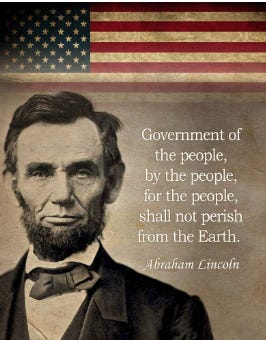
In his Gettysburg Address (1863), Abraham Lincoln defined democracy as a system in which citizens wield power. They participate in governance; their government serves them. He famously riffed on lines from the Constitution:
Government of the people, by the people, for the people.
What is the psychoanalytic significance of all this? Let’s consider the extent to which the average American denies that their own government serves international corporations rather than its citizens. Worse, some corporations, like those refining petrochemicals and slaughtering billions of farm animals, literally kill “the people.” It is too much of an absurdity for even Kafka to dream up (Karbelnig, 2024).
The lies on the EPA website echo Putin’s description of his bloody invasion of Ukraine as a “special military operation.” China, suffering from a property market slump, lower spending, and youth unemployment, uses its “Great Firewall” to suppress the truth, promoting the lie of the “Chinese Dream.” Our own American slogan, calling us the “land of the free,” has pathetically become untrue. We are only free if we can see through the ways we are being manipulated.
The answer to the question posed in the headline, whether Orwellian mind control can be overcome, lies with the power of the ordinary people. ExxonMobil’s Darren Woods earns $36 million per year; Chevron’s Mike Wirth made $26.5 million last year. Heads of major animal agriculture firms, like Tyson, JBS, and Cargill, earn similar salaries. The lobbyists for petrochemical and animal agriculture companies strive to keep the lies alive.
Because they, too, are controlled by major corporations, most of the media that Americans consume propagates the same lies. The untruths and misdirections have converted the “power of the people” into a paradox. On the one hand, it seems a cliché, a hope for potency passively relinquished. On the other hand, when and if the people think critically, uncover the truth, and take to the streets by the millions, then Lincoln’s fantasies of a democracy just might be realized.
Enjoying this newsletter? Consider a free subscription and share it with a friend.
And check out my book, Lover, Exorcist, Critic: Understanding Depth Psychotherapy, available on Amazon.
References
Hitler, A. (1925/1999). Mein Kampf (R. Manheim, Trans.). New York: Houghton Mifflin.
Karbelnig, A.M. (2024). Beyond climate defensiveness: The role of psychoanalysis in creating a sustainable future. The American Psychoanalyst, 58.1:32-45. (March 2024 Issue).
Lincoln, A. (1863, November 19). Gettysburg Address [Speech]. Gettysburg, PA.
Stocker, T.F., Qin, D., Plattner, G.K., Tignor, S.K, Allen, J., Boschung, A., Nauels Y., Xia, Y. Bex, V. and Midgley, P.M. (Eds.). (2023). IPCC Climate Change Report: The Physical Science Basis; A Contribution of Working Group I to the Fifth Assessment Report of the Intergovernmental Panel on Climate Change. New York: Cambridge University Press.